Pressure Washer Hose Harbor Freight . Products come and go, and new products replace the old. 2000 psi max performance electric pressure washer $ 199 99. China High Pressure Water Hose Rubber Flexible Pressure from hengyuflex.en.made-in-china.com Durability and reliability go hand to hand. Get 10% off your entire purchase when you open a new account. Lightweight and portable, this pressure washer features a pressure hose over 20 ft.
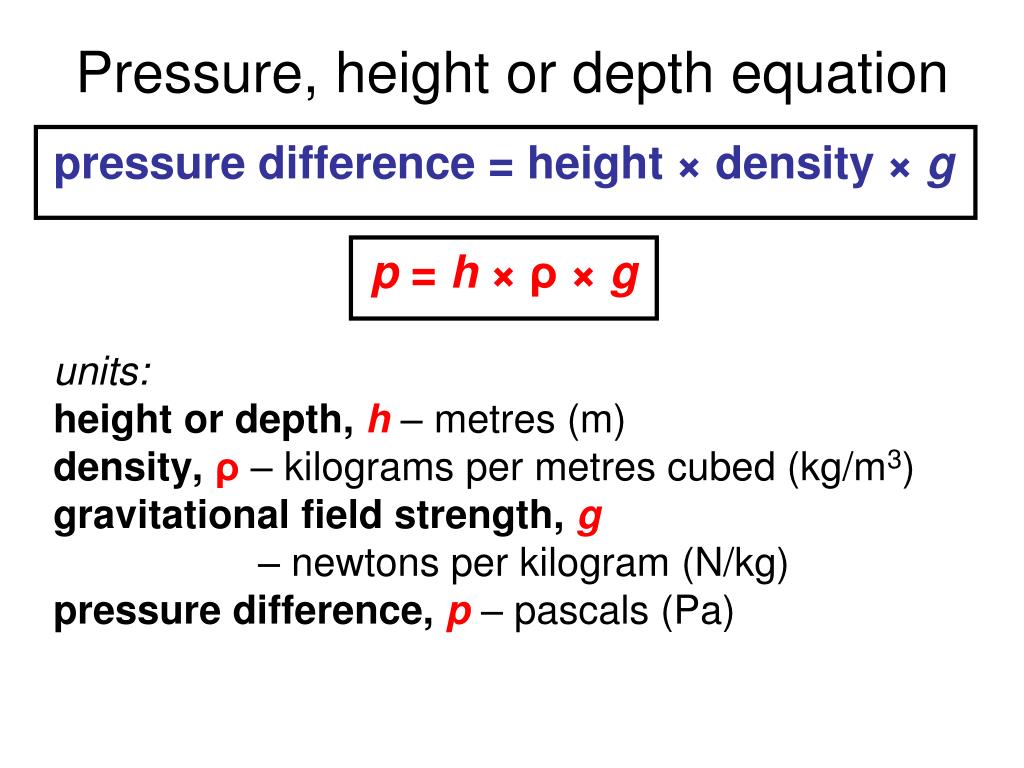
Pressure Formula With Density. = density (kg/m3) g = acceleration due to gravity (m/s2) h = height of fluid (m) or p = pressure head (bar) where: H is the height of the fluid above the object.
PPT EDEXCEL IGCSE / CERTIFICATE IN PHYSICS 51 Density from www.slideserve.com
The water pressure calculation formula is given as: The unit of pressure is pascal (pa). Pressure/head pressure (total force per unit area exerted by a fluid) where:
Pressure Gradient (Psi/Ft) Mud Density (Ppg) X 0.052
The water pressure calculation formula is given as: The unit of pressure is pascal (pa). Pressure = density of a fluid x acceleration due to gravity x height of fluid column.
The Formula That Gives The P Pressure On An Object Submerged In A Fluid Is:
The pressure exerted by a static liquid depends only on the depth, density of the liquid, and the acceleration due to gravity. So the pressure of a liquid or gas is calculated using the following equation: Pressure = density of fluid × acceleration due to gravity × height of the fluid column.
The Pressure Below The Surface Of A Fluid, And In Fact Between Any Two Points In The Fluid Can Be Calculated By The Following Equation:
Click to see full answer. Pressure formula is used to compute force, density, area, pressure, height and gravity. P = ρ ×g × h.
Where, The Height Is H, Density Is Ρ, Gravity Is G.
The depth the pressure is measured at (h), the density of the fluid (p) and the gravitational field strength. The pressure exerted by a column of liquid of height h and density ρ is given by the hydrostatic pressure equation p = ρgh, where g is the gravitational acceleration. H = height of fluid (m)
The Pressure Of Gas Given Gas Density Formula Is Defined From Ideal Gas Equation.
A = total area of the object (m 2) hydrostatic pressure formula is given by. The pressure caused by a column of liquid can be calculated using the equation: Pressure/head pressure (total force per unit area exerted by a fluid) where:


Comments
Post a Comment